
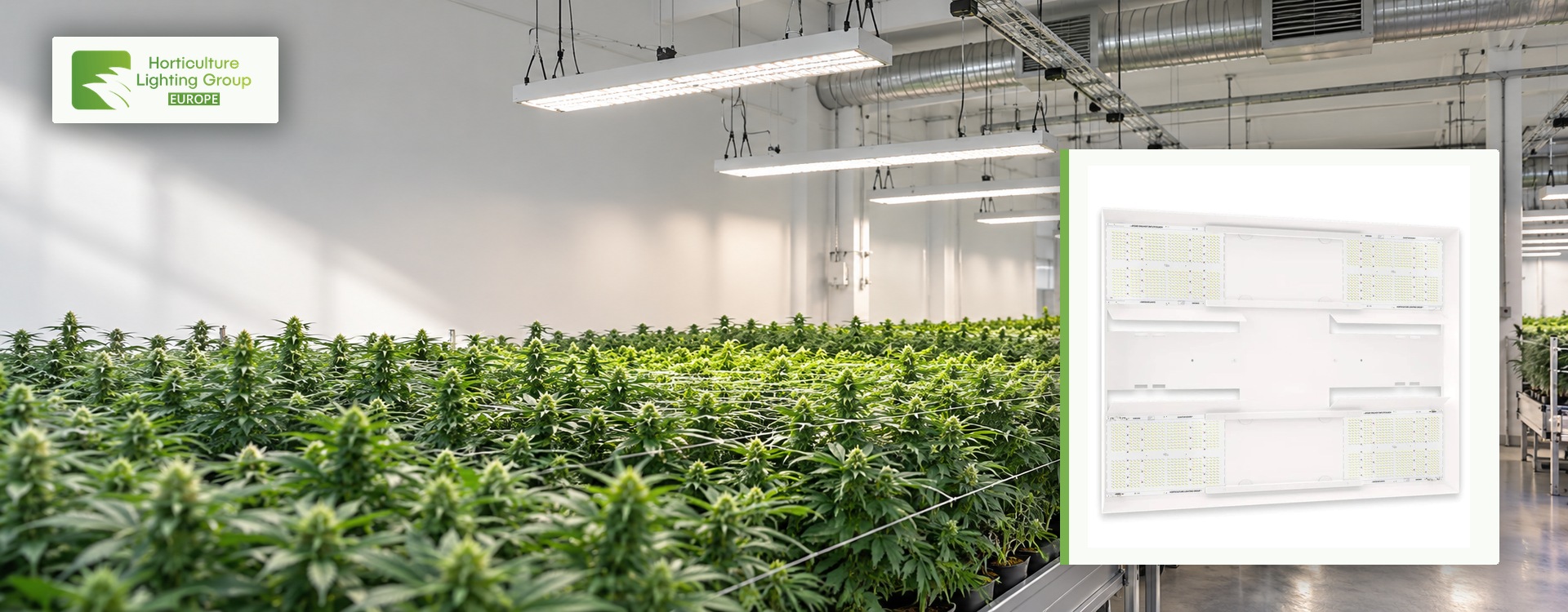
Which HLG light should you choose for your grow tent or room?
Choose an HLG light by starting with the area actually occupied by the crop, the shape of that area and the available height above mature plants. Then define the growth stage and the required intensity at canopy level. Electrical watts help plan supply and heat removal, but they cannot show how much light reaches the corners.
1. Draw the useful growing area
Measure the planted table or canopy, not just the room. A long bench, a square tent and several separated rows require different fixture placement. Allow space for hangers, fans, access and maintenance. A light that physically fits is not guaranteed to spread photons evenly.
For a compact vegetative zone, the HLG 65 V2 is one format to examine. For a longer vegetative bench, consider the HLG 250 Veg Pro. Confirm either option with the exact model's map and the geometry of your space.
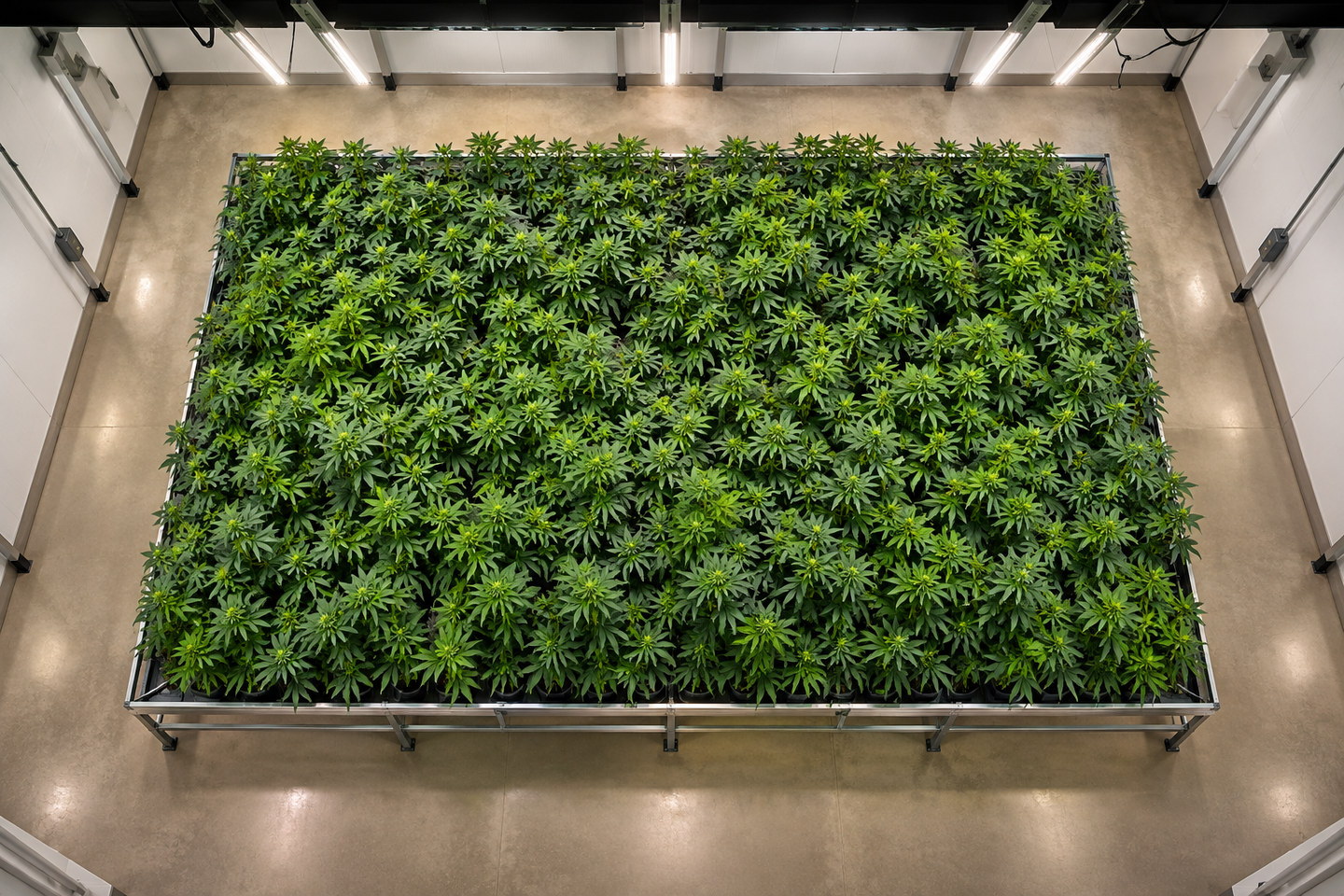
Measure the length and width actually occupied by plants.
Keep these spaces separate from the crop area.
Illustrative scene and teaching markers. No fixture coverage or PPFD measurement is shown.
2. Separate vegetative and flowering needs
Growth stage affects the light requirement and the daily lighting period. PPF, measured in µmol/s, counts photons emitted by a fixture. PPFD, in µmol/m²/s, describes photons arriving on an area at a defined height. Compare distribution over the whole canopy as well as the intended photoperiod. The suitable amount depends on crop species, stage and environment.
The HLG 350 Diablo is a format to assess for a targeted flowering area; the HLG 750 Diablo suits a wider layout investigation. These are starting points, not promised footprints.
3. Check the real hanging height
Measure the maximum clearance between the expected mature canopy and the available suspension point. Include fixture thickness, hangers and room to make adjustments. Limited headroom can concentrate light in the centre; raising a fixture changes both intensity and spread. Follow the manual of the exact version, then measure at the planned canopy level.
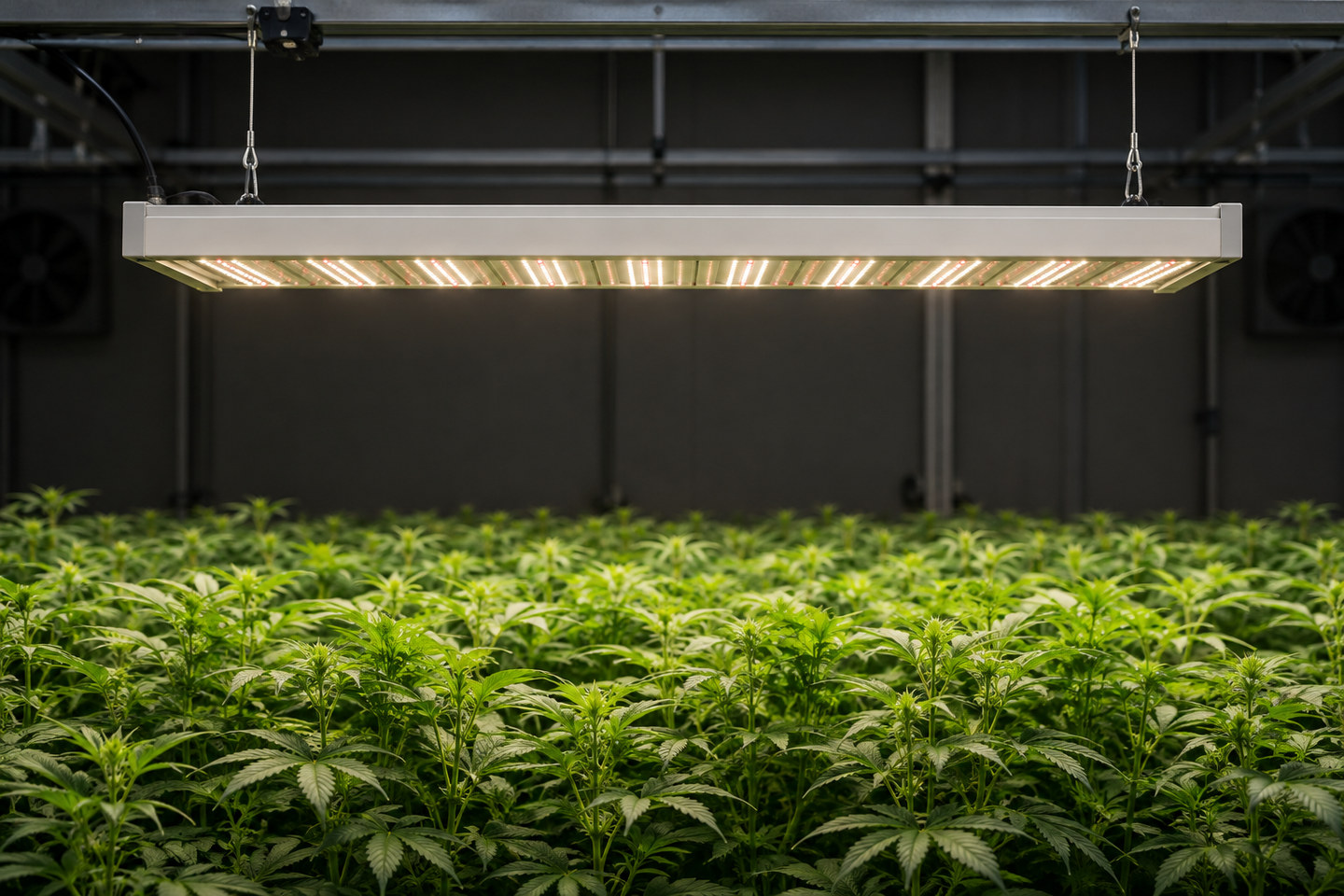
Reserve room for mounting and fixture thickness.
Check distance when the plants reach their planned height.
Generic illustrated fixture. The gap shown is not an HLG mounting recommendation; use the exact manual.
4. Compare distribution, not just the centre
A useful PPFD map states measurement area, height, power and point positions. Compare mean, minimum and edge values, rather than the central cell alone. Reflective walls, other fixtures and the crop layout change real results. Maps made on different areas or at different heights are not directly comparable. Several fixtures may offer flexibility across long tables, but also add suspension and electrical points.
5. Plan heat and electrical supply
Find the exact fixture's maximum input, add loads that will run together and verify the circuit. The energy used by even an efficient LED contributes to the room's heat load. Extraction and cooling also depend on insulation, incoming air and other equipment. Calculate lighting electricity from actual watts and operating hours; whole-room consumption includes ventilation, dehumidification and more.
6. Choose a format with future changes in mind
Shortlist fixtures only after checking crop area, stage, height, comparable PPFD information, electrical load and budget. If the area may expand, reserve mounting space and circuit capacity. Dimming cannot correct a fundamentally poor layout; several small lights make sense only if placement and control remain practical.
Swipe sideways to read the table.
| Situation | HLG starting point | Key check |
|---|---|---|
| Compact vegetative area | HLG 65 V2 | Actual area and headroom |
| Longer vegetative bench | HLG 250 Veg Pro | Distribution along the bench |
| Targeted flowering zone | HLG 350 Diablo | PPFD map at planned height |
| Wider flowering layout | HLG 750 Diablo | Dimensions, load and uniformity |
This table guides further checks; it is not a substitute for the manual or a measurement. Consult the HLG Europe catalogue and LED grow-light category for current products and availability.
Further reading : size a 350 or 750 Diablo layout · read a PPFD map · set fixture height and power.
Common questions
Can watts per square metre select a lamp?
No. That ratio omits spectrum, efficacy, photon distribution and measurement height. It can help estimate electrical load, not guaranteed PPFD.
Does more power always cover more area?
No. Optical design, suspension height and crop geometry determine useful coverage.
Should I buy the largest fixture and dim it?
Dimming is useful, but a large fixture may be awkward in a small room. Confirm dimensions, manual and distribution at the intended setting.
More HLG articles
 HLG 750 Diablo, Diablo X and Diablo ES: what is different?
 HLG 350 Diablo or 750 Diablo: how should you size your lighting?
 PPF, PPFD, efficacy and DLI: understanding grow-light numbers